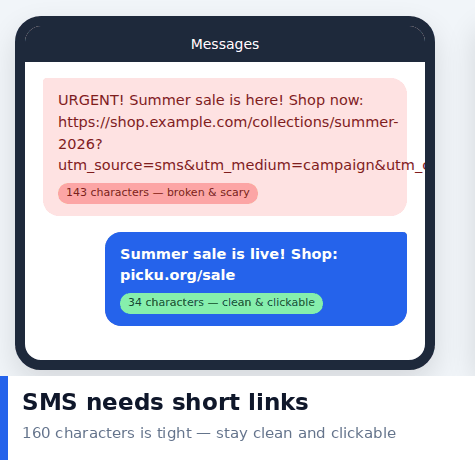
Text messages are the least forgiving place to put a long link. Screen space is limited, messages are billed in segments, and recipients decide whether to trust a link within about a second. A URL full of tracking parameters fails on all three counts.
Short links solve the mechanical problems, and introduce a few considerations of their own around deliverability and trust that are worth understanding before you send anything at scale.
What Long Links Cost You in a Message
The problems are practical rather than aesthetic, and they get worse as volume grows.
- Segment billing. Messages are charged in fixed character blocks, so a long URL can push a message into a second segment and double the cost.
- Visual noise. A URL with several parameters dominates the screen and pushes the actual message out of view.
- Perceived risk. Long unfamiliar addresses are a well known pattern in phishing, and recipients have learned to be suspicious of them.
- Breakage in forwarding. Long links are more likely to be truncated or mangled when a message is copied or forwarded.
Why a Branded Short Link Helps
- Recognition. A domain the recipient already knows removes most of the hesitation before tapping.
- Space recovered. The message can say what it needs to say instead of being mostly URL.
- Tracking. You can see how many people tapped, which a plain link gives you no way to measure.
- Repairability. If the destination changes after sending, an editable short link saves the message.
Deliverability and Filtering
Carriers and messaging platforms filter aggressively, and links are one of the signals they look at. A few choices reduce the risk of a message being flagged.
- Avoid shared domains with a poor reputation. Free shorteners are sometimes abused, and filters treat the domain accordingly.
- Do not send bare links. Always include context so the message does not look automated.
- Keep the same domain consistently. Changing domains frequently looks erratic to filtering systems.
- Include opt out language where required. This is a legal requirement in many regions, not a courtesy.
- Test with your own carrier first. Behaviour varies significantly between networks and countries.
Writing the Message Around the Link
The link is only part of the message. Most tap decisions are made based on the words around it.
- Say who you are. An unidentified number with a link gets ignored or reported.
- State what happens next. Check your appointment tells the reader exactly where the link goes.
- Put the link near the end. Lead with the reason, then give the action.
- Keep one link per message. Multiple links reduce clarity and increase filtering risk.
Tracking Without Breaking the Experience
- Use a distinct short link per campaign. Otherwise you cannot tell which send produced the taps.
- Append parameters on the destination rather than the short link. Keeps the message short while preserving attribution.
- Compare taps against deliveries. A low ratio usually means a trust problem rather than a technical one.
- Watch the timing. Most taps happen within minutes, so a slow trickle suggests delayed delivery rather than low interest.
Compliance Basics
- Obtain consent before sending. This is the foundation everything else rests on.
- Identify yourself in the message. Anonymous commercial messages are unlawful in many jurisdictions.
- Provide a working opt out. And honour it immediately.
- Respect quiet hours. Sending outside permitted times creates complaints regardless of content quality.
- Keep records of consent. Useful when a recipient forgets signing up.
Mistakes That Reduce Taps
- Sending a link with no explanation. The most common reason a legitimate message is treated as spam.
- Using a different domain every time. Destroys the recognition you are trying to build.
- Forgetting that many people read messages on a locked screen. The first few words carry the whole message.
- Linking to a page that is not mobile ready. Nearly every tap comes from a phone.
- Reusing one link across unrelated campaigns. Makes the results impossible to interpret.
When SMS Is the Wrong Channel
Short links make SMS more usable, but they do not make it appropriate for everything. Long form content, anything requiring comparison, and material the recipient needs to refer back to later all perform better in email or in a page they can return to. Text messages work best for time sensitive, single action prompts where the recipient can decide immediately and act in a few seconds.
Link Length and Message Segments
Segment billing is easy to underestimate, because the threshold is not what it looks like at first glance.
- Most systems count characters against a fixed block. A message slightly over the limit is charged as two, not proportionally.
- Links are the largest single component of most commercial messages, which makes them the first place to save characters.
- Accents and emoji can cost several characters each depending on the encoding the message falls back to.
- Test the character count before sending. Most campaign tools show the segment count, and it is worth a look every time.
- A shorter link buys room for better wording. The saved characters are usually worth more spent on clarity than on a longer destination path.
Timing Sends for Better Response
Text messages are read within minutes of arrival, which makes timing far more consequential than it is for email.
- Send when action is possible. A restaurant link sent at midnight will be read in the morning and forgotten.
- Appointment reminders work shortly before the event. Long lead times defeat the purpose.
- Avoid early mornings and late evenings. Both generate complaints regardless of how useful the message is.
- Consider the day of week. Behaviour differs noticeably between workdays and weekends for most audiences.
- Watch your own response data. Your past sends are a better guide than any general advice.
Checking Whether It Is Working
Three numbers tell you almost everything: how many messages were delivered, how many produced a tap, and what visitors did after arriving. If delivery is strong and taps are weak, the wording or the domain is the problem. If taps are strong but visitors leave immediately, the destination does not match what the message promised. Start by measuring the first two properly, since without a distinct short link per campaign the numbers you get will be averages that hide what you actually need to know.