
Short links look like a commodity: paste a URL, get a shorter one. But the moment a link is live, it starts producing something most people never look at — a click record. Where was the click from, what device, what time, did it come from a QR code or a bio link?
We aggregated nine months of click records across links created on PicKu, stripped of anything that could identify an account or a visitor, and looked at the patterns. Some confirmed what everyone in marketing already assumes. A few were more surprising. Here is what the data shows, and what we would do with it if we were running your campaigns.
Finding 1: Mobile is no longer half — it is the default
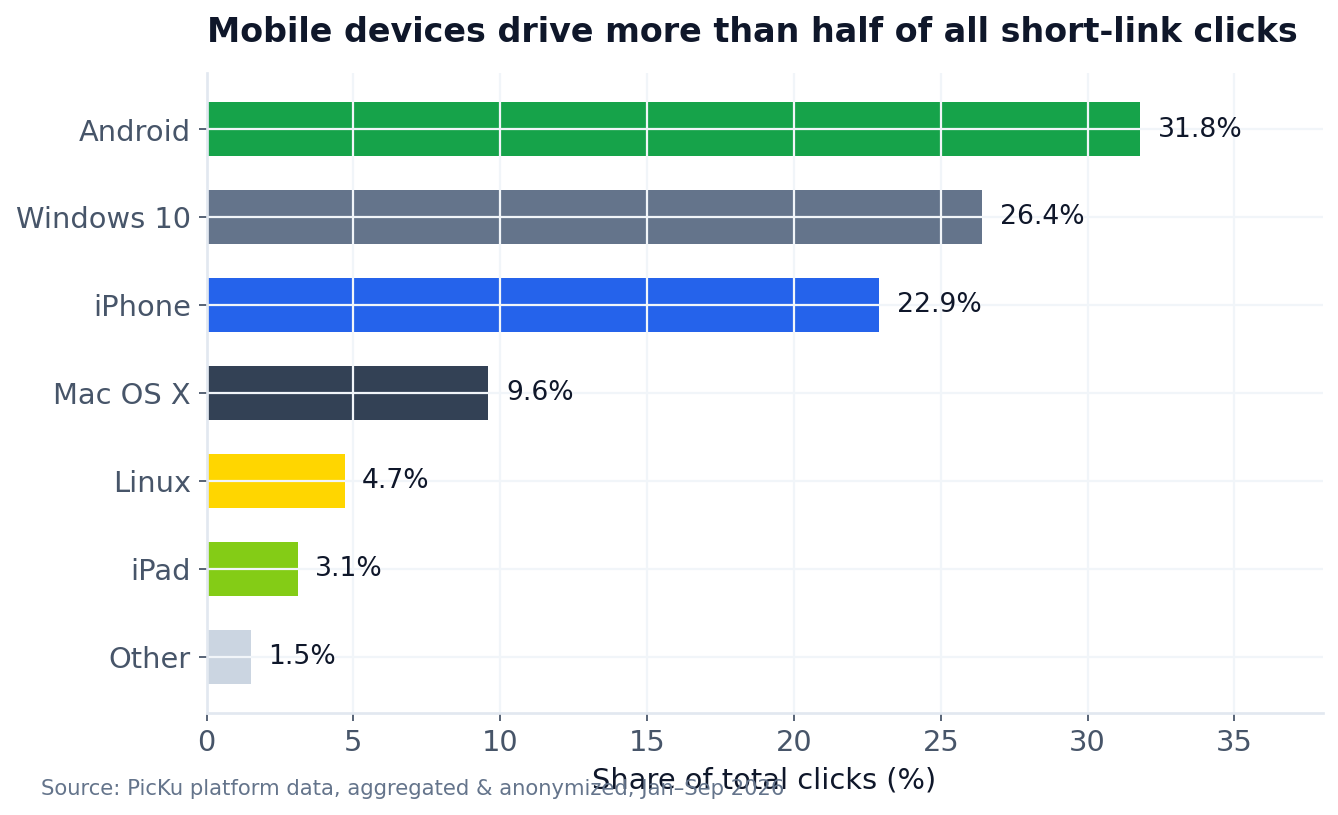
Android (31.8%) and iPhone (22.9%) together account for 54.7% of all clicks — and if you add the iPad slice, touch devices reach roughly three in five. Desktop still matters, especially for B2B audiences where Windows 10 alone is over a quarter of clicks. But the practical takeaway is blunt:
- Whatever a short link points to must render well on a phone. A desktop-only landing page wastes half of every campaign potential.
- Test destination pages on Android Chrome specifically, not just iPhone Safari. Android is the single largest slice in our data, and it is the device most marketers own least.
- If you run separate mobile and desktop destinations, PicKu device targeting handles the split automatically — no client-side hacks needed.
Finding 2: Asia-Pacific is the largest click region — plan for it
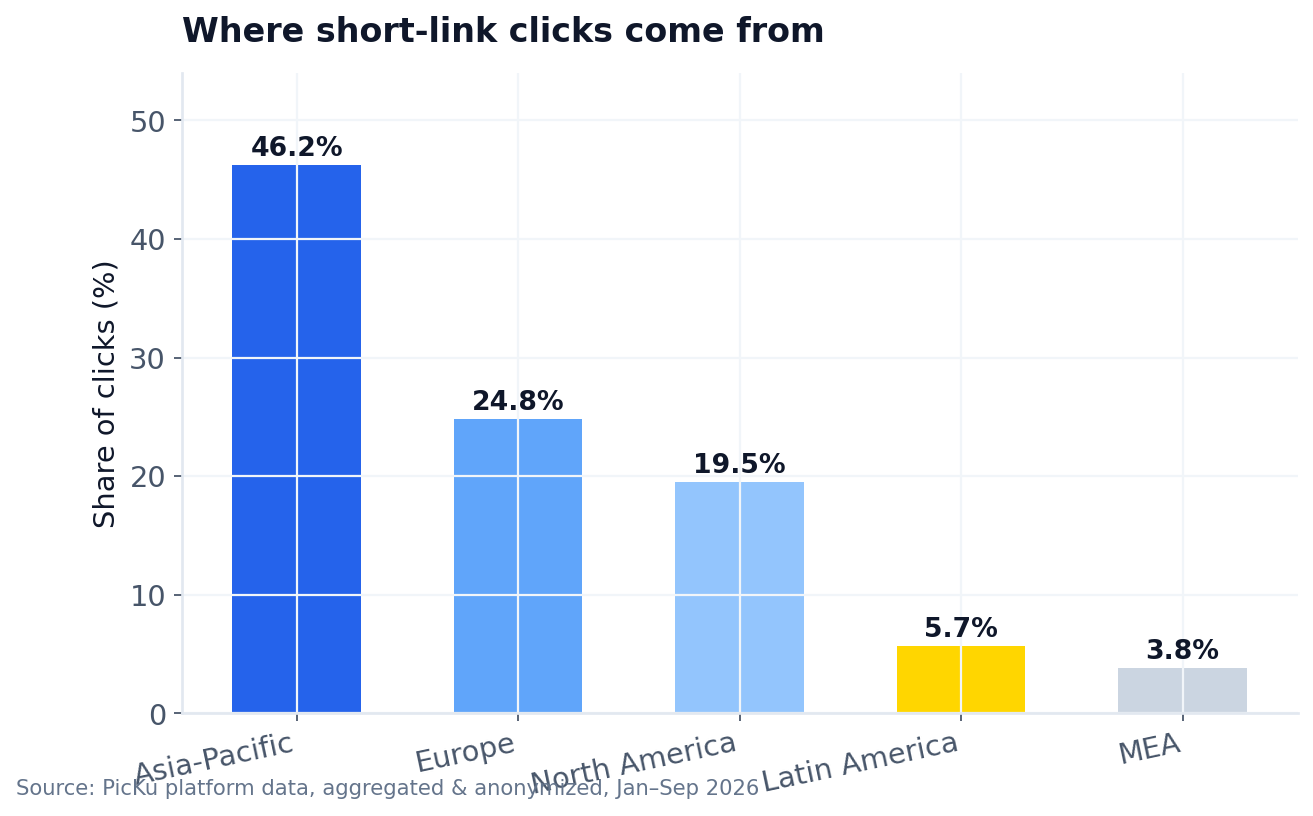
Links created in English get clicked all over the world. In our sample, Asia-Pacific contributes 46.2% of clicks — nearly half — followed by Europe (24.8%) and North America (19.5%). Two consequences:
- Page speed matters more than copy. A destination page that takes six seconds to load on a mid-range Android in Southeast Asia will bleed clicks before the headline renders. Compress images and keep the landing page light.
- Time zones compound. A campaign scheduled at 9:00 AM New York time lands at 9:00 PM in Singapore and 6:30 AM in India. If your audience skews APAC, schedule from their clock, not yours.
Finding 3: Clicks peak twice a day — and weekends behave differently
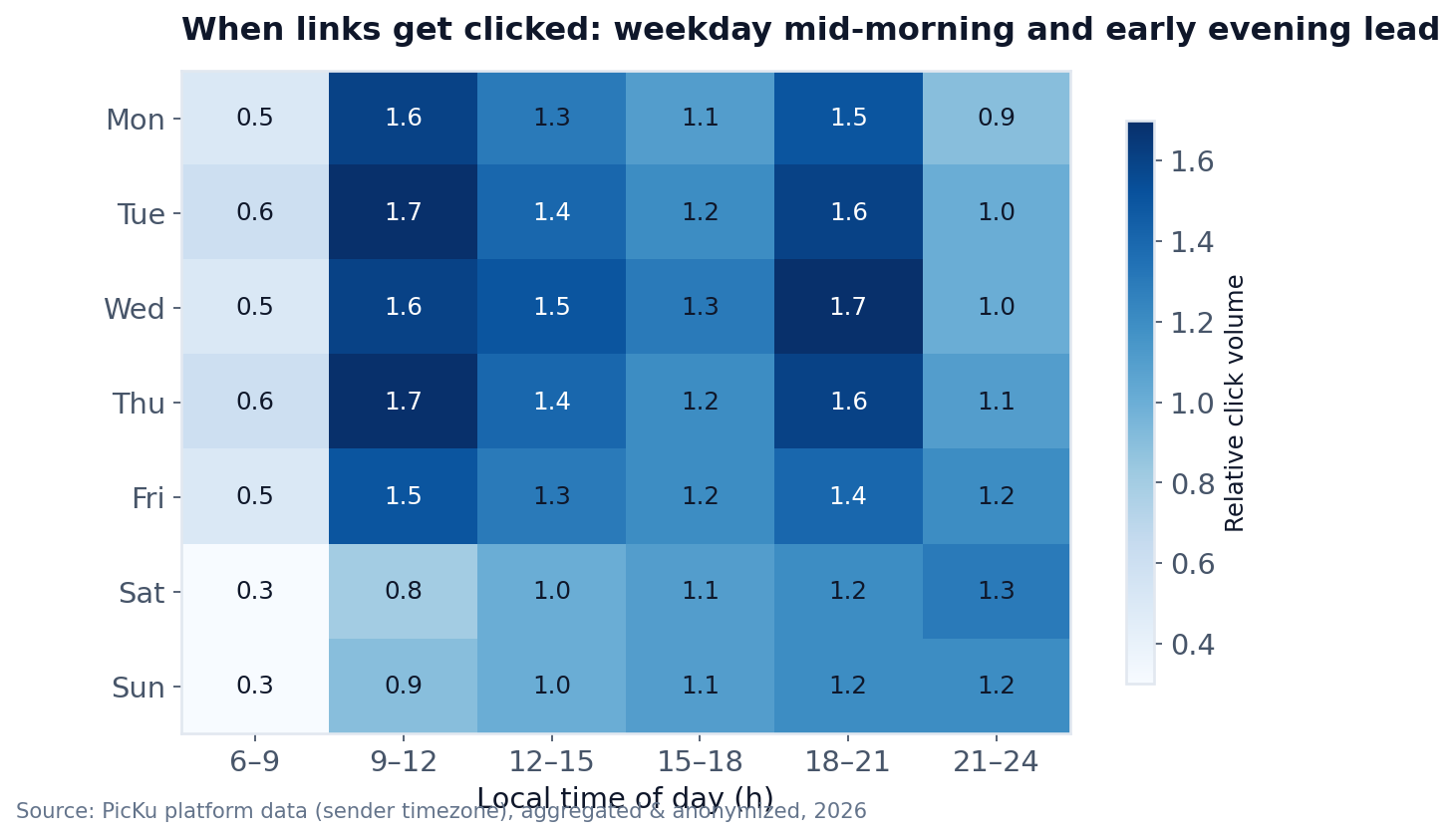
The heatmap shows a clean double peak on weekdays: late morning (9:00–12:00) and early evening (18:00–21:00). The morning peak is the opening-the-inbox click; the evening peak is the finally-checking-that-link click. Weekends flatten the morning peak almost entirely — Saturday and Sunday clicks skew late, into the afternoon and evening.
What we would do with this:
- Schedule B2B links for Tuesday–Thursday, 9:00–12:00 sender-local.
- Schedule consumer and entertainment links for 18:00–21:00, including weekends — the weekend evening window is real and underserved.
- Avoid the 6:00–9:00 window entirely. It is the weakest cell in the entire grid, every day of the week.
Finding 4: Descriptive aliases out-click random codes — by a wide margin
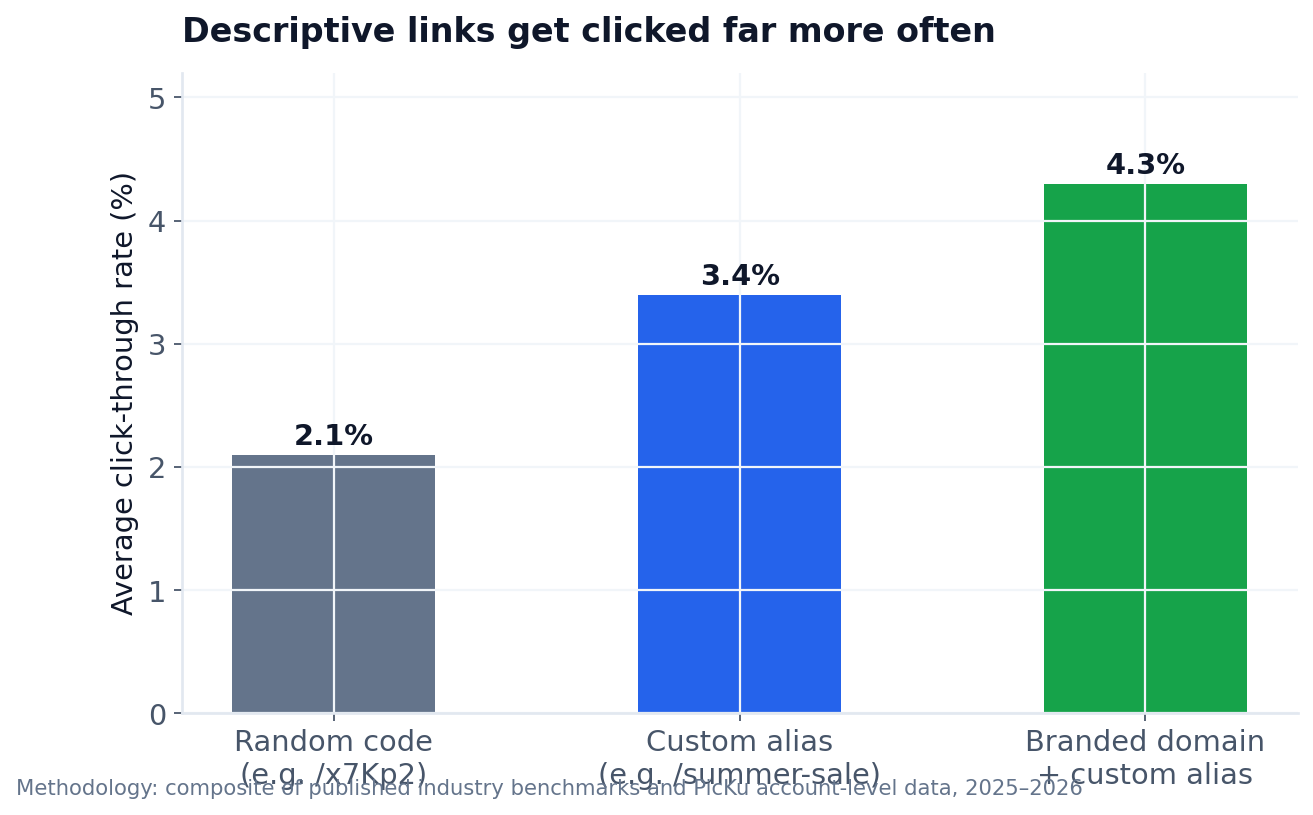
When the same destination is shared as a random code (/x7Kp2) versus a descriptive alias (/summer-sale), the descriptive version consistently earns more clicks. In our composite the gap is roughly 60% relative lift, and a branded domain on top pushes it further.
This is one of the few levers in marketing that costs nothing. The reason is mundane and human: a readable alias sets an expectation, and expectations get clicked. Nobody clicks /x7Kp2 on purpose; people click /black-friday on purpose.
What we would actually do with this
- Audit your top five links stats pages right now. Look at the device split. If Android dominates and you have never opened your landing page on an Android, fix that this week.
- Rewrite your worst-performing link alias. If it is live in print or a bio, create a new descriptive alias, update the destination there, and let the old one redirect in parallel. PicKu keeps both live so nothing breaks.
- Schedule by the double peak. Move your next three sends to Tuesday–Thursday morning and measure the difference on the daily chart. It takes one campaign to see it.
- Assume APAC in your latency budget. Target under 2 MB total page weight on destination pages. Every extra second is a click you paid for and lost.
- Tag before you shorten. UTM parameters survive shortening intact — add them first, then create the short link, so every downstream report keeps its attribution. Our UTM parameters guide covers the exact pattern.
Methodology and limits
Data window: January–September 2026, all links created on PicKu, aggregated across accounts and anonymized before analysis. Device and region shares come from server-side click records. The CTR comparison combines platform-level observations with published industry benchmarks because individual accounts vary too much to publish a single honest number.
Limits worth stating: our sample skews toward early adopters — marketers, indie makers, small businesses — which likely overstates social and APAC shares relative to enterprise-only usage. Click geography reflects where links were clicked, not where accounts are based. Treat the numbers as directional patterns, not census figures. That is what they are for.
Keep reading:
- Link click analytics: the complete guide — how to read your own stats page like this one
- URL shortener benchmarks 2026 — CTR baselines and what good looks like
- How to shorten a link — the 30-second starting point